
Almost every company we talk to wants the same thing: serve more customers, run more operations, and earn more, without hiring at the same pace. And almost all of them have heard the same answer: “just add AI.”
That answer isn’t wrong, but it skips the hard part. Before recommending AI to anyone, we tested it in-house, on the most demanding process we have: building software. We put several AI agents to work in parallel, with one person directing them.
What we learned has little to do with programming. It has to do with how any complex process gets organized: purchasing, invoicing, collections, customer service, operations. Here’s what’s most useful.
The problem isn’t speed, it’s trust
AI is fast from day one. What it doesn’t come with out of the box is a way to trust what it delivers.
It happened to us more than once. In one project, the system reported 1,640 passing tests while the screen’s core function had been broken since day one. In another, an agent read a task marked “pending” and recommended redoing it — even though it had already been done the day before.
Bring that into your business: a report that says “all good” is not the same as the work actually being done. If you automate without controls, all you get is faster mistakes — and sometimes you never find out.
That’s why we stopped asking “what can AI do?” and started asking “how do I know it did it right, without reviewing everything myself?” That question is what turns automation into real productivity.
Lesson 1: order the process first, then automate
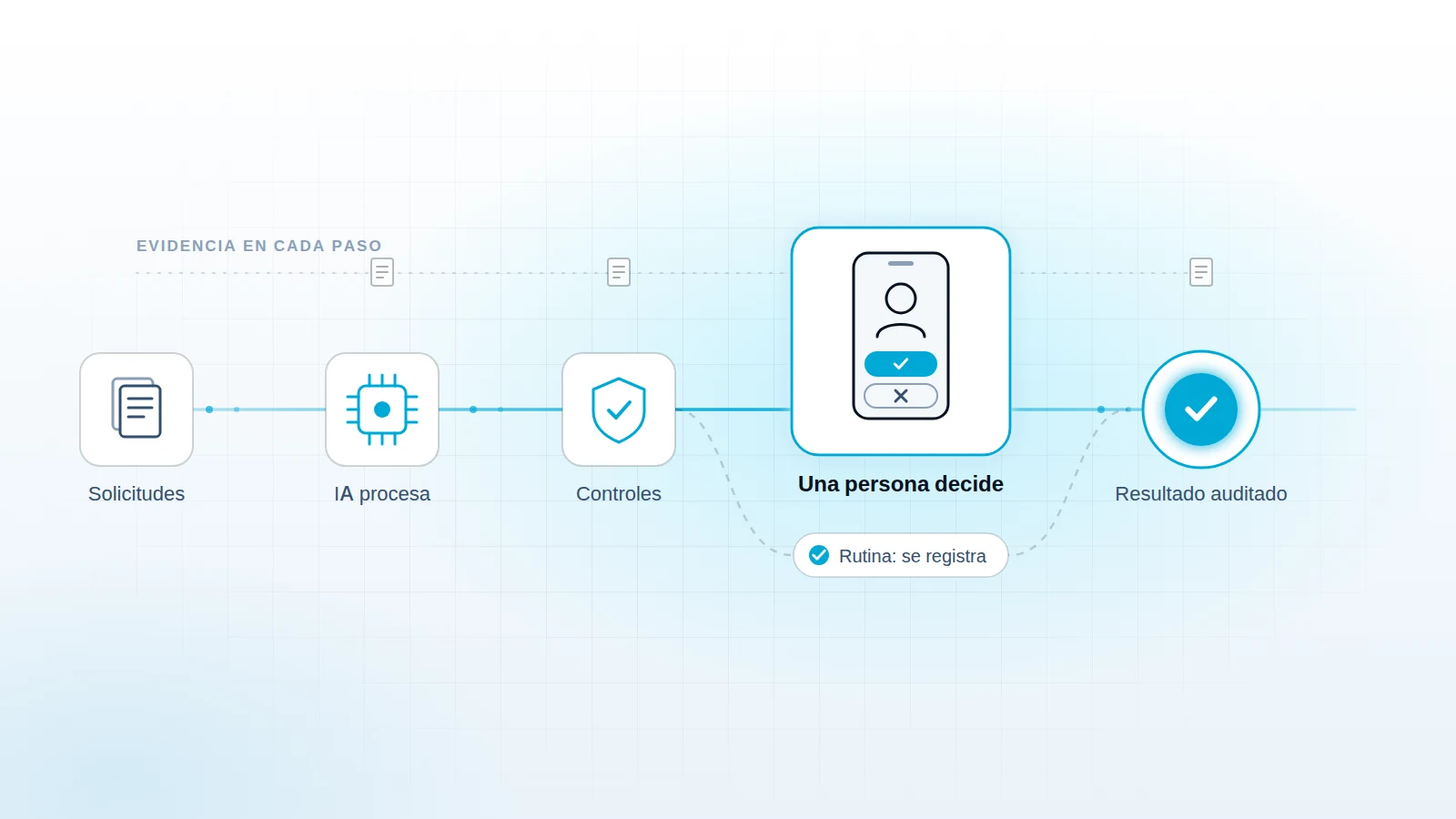
We split our work into clear stages: understand the need, design, plan, execute, review, close. Each stage has an input, an output, and evidence that it’s done: a document, a test, a dated record.
For your business: if no one today can sketch on paper how an order moves from intake to payment, AI won’t fix that. It will inherit the mess. Ordering the process first is what later lets you measure how much you actually gained.
Lesson 2: not everything deserves the same level of control
At first we ran everything through the full process. It was slow and expensive. Today we classify the work, and the question isn’t how big it is, but whether there’s an important decision to make. A big change that’s already decided goes through the fast lane. A small but sensitive one goes through the full process.
And when in doubt, we start with the lightweight lane. If it falls short, it shows immediately and gets escalated. An overly heavy process, on the other hand, never signals that — it just costs.
For your business: approving a small reimbursement shouldn’t follow the same path as amending a supplier contract. Separating the lanes frees up hours without losing control.
Lesson 3: people decide what matters, the machine decides the rest
The typical mistake with “human in the loop” is that the human ends up approving everything. By week three, they approve without reading — which is worse than no control at all.
We classify every decision into three levels:
| Level | Example in a business | What happens |
|---|---|---|
| Critical | An off-budget payment, a change that affects a customer, something irreversible | A person is always asked. If there’s no response, it escalates |
| Routine | Classifying an invoice, choosing between two formats, fixing a minor field | The system decides and writes down what it decided and why |
| Informational | ”Today’s batch closed” | Shows up in a summary, without interrupting anyone |
And when a question needs to be asked, it lands on your phone, with buttons to approve or reject. No one needs to be at a computer for work to keep moving.
The result: your team stops being a rubber stamp and spends its time on the decisions that actually move the business. That’s how you do more with the same people.
Lesson 4: important rules live inside the system, not in the manual
We had rules written down, and they still got broken. A manual only works if the person (or the AI) remembers it at the exact moment it matters — which is when they’re busy with something else.
The fix was turning rules into controls that enforce themselves. If a task tries to change something it shouldn’t, the system simply doesn’t allow it. If the work doesn’t pass its checks, it can’t be marked done.
For your business: “every purchase needs a cost center” can be a paragraph in a PDF, or a required field that blocks the order without it. The second option doesn’t depend on anyone’s memory.
Lesson 5: one single source of truth
When the state of the work lived scattered across several files, it silently contradicted itself. At one point we had seven tasks marked as done with nothing actually behind them.
We fixed it with a single database as the official source. Everything else — reports, dashboards, summaries — gets generated from there, and no one edits it by hand.
For your business: if information lives in three spreadsheets, two WhatsApp groups, and someone’s inbox, every meeting starts by arguing over which number is correct. Unifying the source eliminates that rework before you automate anything else.
Lesson 6: whoever does the work doesn’t review their own work
It’s an age-old internal-control principle, and with AI it’s much cheaper to apply. In our process, whatever an agent produces gets reviewed by four others who weren’t involved, each with a different focus, all at the same time.
Even the “all good” reports get audited. In a recent project, the first two quality reports were wrong, and an independent review caught it.
For your business: a reconciliation, a settlement, or a report for management can go through an automatic second review before it reaches a person. The person only sees what doesn’t add up.
Lesson 7: every cycle leaves a written improvement
At the end of every project we run a retrospective, and what we learn becomes a rule. Our most expensive lesson was trusting a status that said “pending” without checking the actual evidence: the error ended up copied into four documents. Today the rule is that no data enters a report without someone opening the source first.
We also prune. Our internal instructions had grown past 11,500 lines, and reorganizing them cut the cost and time of every task.
For your business: processes fatten up on their own. Every so often you need to ask which steps no longer add anything.
Where does the gain actually come from?
“Doing more with the same people” doesn’t come from AI working faster. It comes from four very specific places:
- Less rework, because errors get caught before they ship.
- Fewer interruptions, because only what matters gets asked.
- Faster approvals, because they get resolved from your phone.
- Less time verifying and more time deciding.
We won’t promise you a percentage without knowing your operation. What we always do is measure how the process runs today, so the improvement can be proven with your own numbers, not a brochure’s.
How to get started in your business
- Pick a process that hurts: high volume, lots of rework, or approvals that stall everything.
- Measure it today: how long it takes, how many errors it has, how many hours it consumes.
- Define what a person decides and what they don’t. That list is worth more than any tool.
- Automate in pieces, with controls and evidence, and compare against your initial measurement.
What we offer
The method we use to build our own software is the same one we bring to our clients’ processes: clear stages, controls that don’t depend on memory, one single source of truth, and people deciding what matters.
AI provides the speed. The process is what lets you trust that speed and turn it into money.
Do you have a process that eats up more people than it should? Let’s talk and review it together.